
YOUR PAY, CLEARER
Does Night Shift Differential Count Toward Overtime Pay? A Guide for Nurses
Educational guide for U.S. nurses · Sources checked against U.S. Department of Labor guidance, November 2, 2026
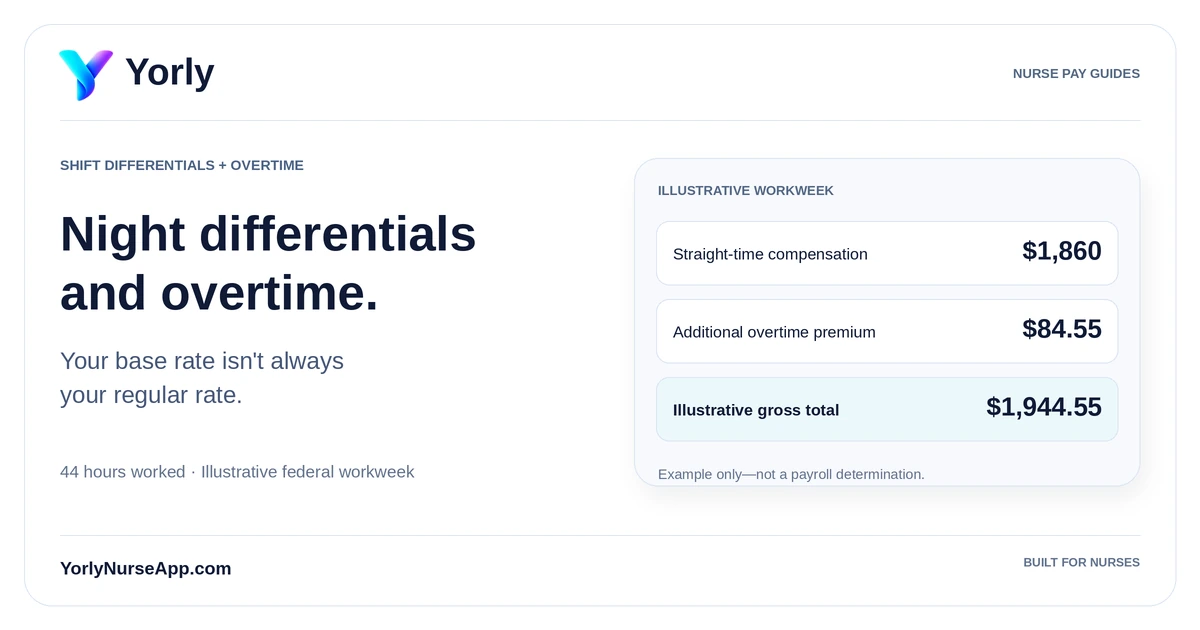
When you're deciding whether to pick up another shift, your hourly base rate is only part of the picture. Night and weekend differentials, pickup bonuses, and overtime can all affect your earnings. One especially common question is: Does a night shift differential count when overtime pay is calculated?
Generally, yes. For employees covered by the federal Fair Labor Standards Act (FLSA) who are eligible for overtime, shift differential pay is generally included in the regular rate of pay used to calculate overtime. That regular rate may be higher than your base hourly rate. The U.S. Department of Labor specifically identifies leaving shift differentials out of the regular rate as a common overtime error in healthcare. [1]
Your base rate isn't always your overtime rate
A nurse might earn $40 per hour as a base rate and receive another $5 per hour for eligible night hours. It can be tempting to assume overtime always means $40 × 1.5, or that every overtime hour automatically earns $45 × 1.5. Neither assumption reliably accounts for a workweek containing different shifts.
Under the standard federal overtime approach, the regular rate is generally calculated by dividing compensation that must be included in the regular rate by the total hours worked during the workweek. For covered, nonexempt employees, overtime is generally owed after 40 hours in a workweek at not less than 1.5 times that regular rate. [2]
A simple example with a night differential
Imagine a nurse works 44 paid hours in one workweek:
Illustrative federal 40-hour workweek example. Amounts are in U.S. dollars. On smaller screens, scroll the table to see every column.
| Pay component | Calculation | Amount |
|---|---|---|
| Base earnings | 44 hours × $40 | $1,760 |
| Night differential | 20 eligible hours × $5 | $100 |
| Straight-time compensation | $1,760 + $100 | $1,860 |
| Regular rate | $1,860 ÷ 44 hours | About $42.27/hour |
| Additional overtime premium | 4 overtime hours × 0.5 × ($1,860 ÷ 44) | About $84.55 |
| Illustrative total gross pay | $1,860 + $84.55 | About $1,944.55 |
This example assumes all 44 paid hours are hours actually worked, with no paid leave or other compensation. The calculation retains the unrounded regular rate until the overtime premium is rounded to cents.
Why is the additional overtime premium calculated at half the regular rate here? Because the first, straight-time portion of all 44 hours is already included in the $1,860. The extra half-time premium brings the four overtime hours up to time-and-a-half. This is an illustrative application of the federal regular-rate method, not an individualized payroll determination. [2][3]
Your actual paycheck may differ due to state law, employer agreements, additional premiums, excluded compensation, or a different applicable overtime arrangement.
What about pickup bonuses and weekend differentials?
Weekend and evening differentials are generally treated like night differentials for purposes of the federal regular-rate calculation. A promised pickup bonus may also need to be included, depending on its terms and whether it qualifies for a statutory exclusion. The fact that a payment is called a “bonus” does not automatically mean it can be left out. [1][3]
This is why looking at the entire compensation picture matters more than looking at a single advertised pickup incentive.
Are hospital overtime rules ever different?
Yes. Under a specific FLSA provision, eligible hospitals and residential care establishments may use an “8 and 80” overtime system when its conditions are met, including a prior agreement or understanding. In that system, overtime generally applies after eight hours in a workday and after 80 hours in a fixed 14-day work period, with rules designed to avoid double-counting overtime premiums. This is not the default for every nurse or healthcare workplace. [1]
State laws and applicable agreements may also provide additional protections. Check the rules that actually apply to your position and employer.
Three questions to ask before picking up an extra shift
- How many hours will I actually be paid? Account for any unpaid meal periods and other applicable paid-time rules.
- Which premiums apply, and to which hours? Night, weekend, and pickup incentives may have different eligibility rules.
- Will this shift trigger overtime? Consider your full workweek and the applicable overtime arrangement—not just the shift in isolation.
PUT YOUR SHIFT IN PERSPECTIVE
Estimate your shift earnings with Yorly
If you're comparing a potential pickup shift, start with the free Yorly Nurse Shift Pay Calculator. Enter your base hourly rate, paid hours, eligible night and weekend differential hours, and any flat pickup incentive to see a simplified estimated gross shift amount.
Important: The free calculator does not calculate overtime premiums, taxes, take-home pay, or whether your employer is complying with wage laws. Do not use its result to determine what you are legally owed for an overtime workweek.
Try the free shift-pay calculatorA LITTLE MORE CLARITY
Frequently asked questions
Does a night differential count toward overtime under federal law?
Generally, yes. For covered, nonexempt employees, shift differentials are generally included in the regular rate used to calculate overtime. [1]
Is overtime always based on my base hourly wage?
No. The federal regular rate can include additional compensation, such as shift differentials and certain bonuses, so it can be higher than your base wage. [2][3]
Do nurses automatically get overtime for a 12-hour shift?
Not under the standard federal 40-hour workweek rule solely because a shift exceeds eight hours. However, an eligible healthcare employer may use the special 8-and-80 system, and state law or an agreement may provide additional rights. [1]
Can Yorly's free calculator check my overtime paycheck?
No. It estimates basic gross shift earnings using the amounts you enter. It does not determine legally required overtime pay or audit payroll compliance.
Sources
- U.S. Department of Labor, Fact Sheet #54: The Health Care Industry and Calculating Overtime Pay.
- U.S. Department of Labor, Fact Sheet #56A: Overview of the Regular Rate of Pay Under the FLSA.
- U.S. Department of Labor, Fact Sheet #56C: Bonuses under the FLSA.
This article provides general educational information about U.S. federal wage rules, not legal, tax, or individualized payroll advice. Applicable state laws, employment agreements, exemptions, and circumstances may change the outcome. For questions about your pay, consult your employer's payroll team or a qualified professional.